It's just warm enough for the bees to fly today. They have been cooped up for several weeks, due to the extremely low temperatures (from about 10C to -5C). Today is about 13C (at the time of observation), overcast, with light winds.
There were quite a few dead bees in the snow around the hive a week ago. I presume they came out in response to a sunny warmish day - and found that it was colder than they thought [sic].
Did they take off and then crash and die? Or did they come in for landing and not make it onto the landing board? But for sure, when they hit the snow, they were doomed.
All the books say is "They will come out to defecate and then return to the hive". They don't say "Some bees will have suicidal tendencies".
So I continue to observe, learn and puzzle. The more I see, the less I know. However, I am relieved that they are still in the hive in good numbers. They have plenty of food (see previous blog on giving them some Apifonda - like bakers' fondant icing). So all bodes well today.
I must get a good thermometer to record the temperature at which various behaviours occur.
Sunday, 15 February 2009

Tuesday, 13 January 2009
Bring out your dead!

Today is the first mild day in January - about 10C. It's sunny and calm. So I thought the bees might be active, and they were.
I was worried that the cold weather had killed them off. But I needn't have worried. As my beekeeping friend Brian said "It's the best thing for them. They form a ball in the middle of the hive and don't use any energy. The worse thing is mild weather - which encourages them to fly and use energy, which they then replenish by eating their stores."
The dead bees on the landing board (in photo) have been brought out of the hive by the worker bees and, well, dumped on the landing board. I'll scrape them off when the bees have packed it in for the day.
I opened the hive and removed the empty Apistan container (the Verroa treatment). The hive was completely full of bees. I need not have worried.
But I made the mistake of not using smoke to pacify them. They were CROSS and many attacked me. I made another (maybe) mistake by not wearing my overalls. I wore a black fleece jacket and they really went for it. It's outside the back door now, covered in bee stings. Of course, that's the end of the bees that did the stinging, so I'm feeling bad about that mistake.
They might have attacked me for a number of reasons, but they are docile colony normally. Reason one: I didn't use smoke. Reason two: it's cold and they were not keen on being opened up. Reason three: they are not busy gathering nectar, so had nothing better to do. Reason four: they didn't like my black fleece.
Anyway, I gave them some Apifonda - which is sugar, rather like pre-mixed cake icing. You pierce the 1000g bag and place it - holes down - on top of the frames. So that's will keep them fed for a good few weeks.
I didn't pull out any of the frames for fear of chilling the brood - if there was any - which I doubt.
So that's it for a month or so.
A few mistakes made and lessons learned.
Friday, 9 January 2009
Honey Show at Lackham


This is my first attempt to post photos.
Lackham College is the local agricultural college - and home of the beekeepers apiary.
We have an annual family day and show off our wares.
Here John is putting a badge on an interested you ng visitor.
And second, John opening the demonstration hives to show the visitors what a frame of bees looks like.
I've been blogged!
My very good friend vegplotter visited me to help me open the bees and have a look-see.
She took some photos and, being an organised sort of person, put the photos on her blog.
She took some photos and, being an organised sort of person, put the photos on her blog.
Ivy Emergency!
I'm a bit late posting this, but here goes.
In late September I had to return the borrowed hive to the lovely local beekeepers that lent it to me - so I bought my own and built it from flatpack.
When we opened the hive to do the replacement we found lots of bees clustering on the outside of the hive (well, to be accurate between the lifts of the WBC hive and the inner brood boxes and supers). We soon found that the broodbox was stuffed full of ivy honey. You can tell it by the rank smell.
Emergency measures were needed!
After some debate (phone a friend?), we decided to remove a frame of honey stores and replace it with a frame of empty foundation and put on a super of drawn comb (another loan from my lovely friends), and hope that would do the trick.
I added a feeder full of sugar syrup to the top of the super and closed it up, and hoped for the best.
All seemed well, but they were not happy girls. We disrupted them so much that a few did try to follow me back down the garden and sting me. They are normally very docile.
Lesson? There's a lot to learn. The large flow of ivy honey and the great increase in the size of the colony took me by surprise.
You may be wondering what I did with the honey. Well, I made another mistake. I uncapped it by running a large flat hot knife across the surface of the comb to remove the cappings, exposing the honey in the cells. I hoped that it would then run out through gravity. But no. Being ivy honey, it crystalised overnight and left me with a brick of solid comb. I may give it back to the bees in the spring and see what they can make of it. It's of no use to me. Interestingly, I thought the ivy honey was quite nice tasting. Strong, but not unpleasant.
In late September I had to return the borrowed hive to the lovely local beekeepers that lent it to me - so I bought my own and built it from flatpack.
When we opened the hive to do the replacement we found lots of bees clustering on the outside of the hive (well, to be accurate between the lifts of the WBC hive and the inner brood boxes and supers). We soon found that the broodbox was stuffed full of ivy honey. You can tell it by the rank smell.
Emergency measures were needed!
After some debate (phone a friend?), we decided to remove a frame of honey stores and replace it with a frame of empty foundation and put on a super of drawn comb (another loan from my lovely friends), and hope that would do the trick.
I added a feeder full of sugar syrup to the top of the super and closed it up, and hoped for the best.
All seemed well, but they were not happy girls. We disrupted them so much that a few did try to follow me back down the garden and sting me. They are normally very docile.
Lesson? There's a lot to learn. The large flow of ivy honey and the great increase in the size of the colony took me by surprise.
You may be wondering what I did with the honey. Well, I made another mistake. I uncapped it by running a large flat hot knife across the surface of the comb to remove the cappings, exposing the honey in the cells. I hoped that it would then run out through gravity. But no. Being ivy honey, it crystalised overnight and left me with a brick of solid comb. I may give it back to the bees in the spring and see what they can make of it. It's of no use to me. Interestingly, I thought the ivy honey was quite nice tasting. Strong, but not unpleasant.
Wednesday, 20 August 2008
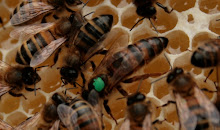
Where is the queen?
The queen is in there somewhere!
But I'm not experienced enough to spot her in a broiling mass of bees on a frame.
I have opened the hive a couple of times and looked for eggs. They're there - but very hard to spot, especially with my bi-focals. And there's quite a bit of uncapped brood - ie. eggs that have developed into larva in cells, but the cell has not yet been capped by the workers.
If I could find the queen, I might be able to mark her. But a) I can't see her (she may be lurking on the floor of the hive); and b) even if I could, I wouldn't know how to.
Lots to learn.
Problems with wasps
It's now August and wasps are sniffing around the hive. I have seen a few in mortal combat with my bees, and the wasp is usually the winner.
I've set up a wasp trap and it seems to be collecting a good number of the stripey little b**tards!
Subscribe to:
Posts (Atom)



 Posts
Posts

