Search This Blog

Sunday, 17 January 2010

Four out of four ALIVE

I've just been on a cycle tour of my hives - about a 6 mile round trip - on the first mild sunny day for quite some time. We've had freezing temperatures for about a month.

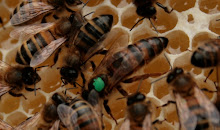
And I'm glad to report that all four hives have live bees. See photos below for proof. I was sure that the weakest of the four would perish in the cold.

I hadn't given them the oxalic acid varroa treatment that I had bought, mainly on the grounds that I am so hamfisted that I would make a mistake and do more harm than good. Second, opening them up in December would surely chill them. Third, who wants acid poured over them in winter? Seems draconian and highly interventionist. Fourth, they are all on new comb this year, so there might not be a big varroa problem.

BUT (and this is a big BUT) the life of the overwintering bees is significantly reduced by varroa. They might be here now in early January, but will they still be here in early March, when (I hope) the queen will recommence laying new brood? We will see. The die is cast now. I don't think putting on oxalic acid now will help matters. Any views?

And Harriet (see previous posts, and top right in photo) now has a couple of friends to lift her out of depression. And the buzzard that lives in the trees behind Harriet's field was there today as well. Always a pleasure to see.

Rather a grotty mess on the landing board. So I swept in off with my gloved hand, only to be rewarded with a sting on the back of my neck.


Thursday, 31 December 2009

Happy new year to all my readers!

I'm now the editor (and printer, enveloper, stamper and poster) of Beelines, the Monthly Newsletter of the Melksham and District Beekeepers Association.

In line with the infamous Peter Principle, the club has chosen the person with least beekeeping nous to take up the position.

I would like to publish it on the blog, but it contains member's names, so I can't. But I can show you the rather subtle Photoshopped photo that I put on the front page.

You might recognise the photo from the blog. It was taken by son Tom with a Canon DSLR. If you want to take bee photos, a DSLR with 12M pixels is essential. Getting bees in focus still requires the skill and eyesight of an 18 year-old.

My last contact with the bees was trying to fit a mouseguard to one. Although I used the utmost stealth, I was attacked by a host of angry bees and stung on legs and ankles (head and arms were luckily protected). They really don't like being approached when it's cold and windy and there is no honey flow. Good luck to any mouse that tries to make that hive a home.

I have decided against giving any hive a Oxalic Acid varroa treatment. Not because I don't think it will work, but because I am so incompetent (cack-handed, does that translate?) that I am likely to harm them inadvertently.

I will be reporting on the health of my four hives in the new year.

Happy new year!

Saturday, 12 September 2009

Bees on the ivy

Three photos taken today whilst Mrs S was collecting sloes for her gin. Normally sloshes it back with the merest hint of tonic, but she wants to make some Christmas presents. Bottle of Sloe Gin, Jar of Honey, pound of plum jam - what's not to like?

The first is of a bee with a lorra lorra pollen. Note the two big arange stripes on the abdomen - I think that makes her an italian strain. Well, she was flapping her wings a lot and nipping from flower to flower, so I think that must be right.

The second is a rather venerable old worker - she has lost most of her hair. Her black abdomen marks her out as an English strain. She worked the same flower head for about five minutes with infinite patience.

Third one has rather odd markings - the orange band doesn't go right across.

If you have a chance, go an sniff some ivy flowers. You'll be surprised by the rank smell - a bit like a wet bed full of bedbugs (older readers only perhaps). That's what the honey smells like.

My new friends C and L gave me a pot of ivy honey and I made some experimental flapjack for sale at the honey show last week (sorry no photos - I was in the catering tent all day). I thought the flapjack was disgusting, but it all sold, even with a health warning.

And I sold four jars of honey (half-pounders) at £3 a pop. Can't be bad.

Say hello to Harriet

Harriet is a rather lonely cow, suffering from post partum depression. Now, I'd be the first to admit that my knowledge of bovine psychology is a bit, well, sketchy. But she did have a stillborn calf, and she has rather a mad look in her eye.

She lives in the field beside my most recent apiary. So I have added a barmy bovine to the guard sheep at the other apiary, in a bid to gather a Noah's Ark of bee protectors - a Rainbow Army, if you will, of farm animals.

Adding fondant

Much to my surprise, two of the three hives that I inspected over the last two days were practically devoid of honey stores.

The two hives have very large colonies and I guess that a lot of bees need a lot of food. The smaller colony in the third hive (that I have complained about in previous posts) is still small, but quite well provided for.

There seems to be a gap between the end of the summer flowers and the ivy coming on stream.

In first photo, I cut a window in the fondant package.

In the second photo, you can see it placed window-side-down over the opening in the top cover (which in this case is perspex.)

Each bag is 2.5kg of a mix of -oses (sucrose, glucose, etc) that the bees find amenable.

They will take this bagful down into the comb within a week. And at a few micrograms at a time, that's a lorra lorra trips.

Tuesday, 1 September 2009

Hornets - huge brutes!

See this huge hornet that I caught (with half a dozen others) in my wasp trap.

It's almost 3 cm nose to sting. Below it are a wasp and a worker bee. You can see how a few hornets could devastate a hive.

Vespa Crabro, if you're interested.

Cretan Honey

I bought three jars.

From left to right, they are:
  • from supermarket, complete with Lot No. Full EC compliance. The clearest.
  • from a babushka at the side of the road, no label, but from Thyme (she said)
  • from Agios Nikolaus (St Nicholas) market stall on market day. Claims to be "Sage and Various herbs" (Daifora botana).
All delicious, needless to say. Cost? Between Euro5 and Euro6 per 225 g jar.