Search This Blog

Wednesday, 4 May 2011

Carbon Dioxide Experiment


A very experienced beek who I heard talk the other days said that CO2 would anaesthetise bees. This can be very useful when conducting artificial insemination.

Now you don't need me to tell you that I'm not planning any of that stuff - the clue is in the title of the blog :-)

But I am always fascinated by gadgets, and I am nervous about handling queens, so I bought a CO2 spray that is intended for cleaning cameras, etc. See photo below. Your for £10 from ebay.

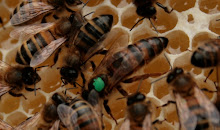
I then put ten bees in a tupperware box and gave them a good squirt of CO2. Result: apparently dead bees. See next photo.

Ten minutes later ........


Mortality rate: 0%.

So I shall use this technique for putting queens into queen cages. Very useful for someone as hamfisted as me.

Tuesday, 26 April 2011

Topbar is dead

Went to inspect the topbar only to find a pile of dead bees and the comb being munched by wax moth.

The only satisfaction was feeding wax moth larvae to the chickens.

They didn't starve, there was still honey in the comb.

Probably virus damage as a result of varroa. The topbar is hard to treat. You can't close it up for Apivar to have the maximum effect, and you can't dribble oxalic acid because the bars are closed up.

It might be possible to fume them using an oxalic acid heater and crystals, but to be honest, I'm not going to bother finding out.

I think the topbar must find a new home.

Monday, 18 April 2011

First try at queen rearing

Here are the apideas that I bought last year. They are Swienty brand - and there are many others. Reading the reviews, I think perhaps Swienty are not the best.

This first photo shows the mini-frame with the foundation strip, held in place by molten wax applied to the edges.

The second photo shows the feed chamber, loaded with Apifonda (bee candy) with a piece of balsa wood on top for bees to stand on rather than fall in and get stuck. Note the queen excluder on the upper right - to stop the Queen getting stuck in the apifonda.


Third photo is of the painted nucs. Each a different colour. Should be a green one, rather than two shades of blue, but I didn't have that paint in the shed. Note the entrance on the middle nuc is open.

Final photo is of the nucs in position. I stocked each one with 300gm of bees (well, OK, a scoopful) and a queen cell from friend Emma's gentle bees. She had eight QCs to deal with. So one of these queens (if successful) will go back to her.

Sunday, 20 March 2011

Opening the topbar or the first time this year

Hive opened on a lovely sunny calm day, about 14 c.

The photo above shows four bars, upturned and stood on top of the hive.

Several things to note:

Stores
There is still something to eat. The wider comb nearer the bar is still full of sealed honey.

Beespace
The two pairs of bars show the beespace that that bees naturally make between comb. It's not regular. It is wider at the tip of the comb, where more bees need to pass one another, and narrower at the bar, where honey is stored, capped over, and through passage is not required.

The starter strip
You can see the groove that I have put in the bars - with a circular saw. I filled this with wax to give the bees a guide (a strong hint, if you like) on where to put their comb. They complied on most bars, but the central bars have crossing comb that is also glued to the inside of the hive, so I can't remove them for inspection.

Colour of the comb
The comb is quite dirty where the patter of many tiny, dirty, feet has walked. The cleaner comb is almost white, and obviously much newer.

Of course, one of the features of a topbar is that the comb that this year contains honey might last year have contained brood. Yum! A bit too natural for my liking.

Sunday, 13 March 2011

Busy bees and yellow pollen


Yes, I know, pollen is often yellow, but this is bright yellow. I think it is daffodil, or perhaps Forsythia (sp?).

Both out-hives, a mile from home and a couple of miles apart, are bringing it in.

It's a lovely sunny day, but quite cool at about 11-12 c.

They are munching their way though the apifonda - especially the aggressive lot in the field.

All three colonies are doing well. Which one to raise queens from, that is now the question? Certainly not the aggressive ones. We will see. More to follow on this subject.

Friday, 18 February 2011

Crocus pollen

At about 10 degrees (c), bees were bringing in crocus pollen. Vivid orange/yellow and unmistakable.

It's a good sign of a healthy colony.

Tuesday, 15 February 2011

Topbar colony still alive!

Despite the harsh winter, the colony in the topbar hive is still alive.

The bottom of the hive is just mesh - so the colony is exposed very directly to the elements.

Just goes to prove - something, anything - depending on your prejudices :-)

This colony was a fresh swarm last June (see previous posts about my two sons collecting their first swarm from high in a tree, with advice from me in India via mobile phone).

So a swarm in June is worth a silver spoon.